 ZoneFlow
ET, Temperature Tiers or a Soil Sensor for Watering
When you set up a zone, ZoneFlow has to decide how much water a hot week should get compared with a cool one. People often ask which method is best. The honest answer is that they are good at different jobs, and the best results usually come from using two of them together.
Three ways to know what a plant needs
Temperature tiers are a rule of thumb. ZoneFlow takes the average of the last three days' highs and puts the zone in cool, normal or hot. Each tier has its own weekly water target. Hotter weather means more water. You can see the rule, you can change it, and it is hard to get badly wrong. This is the default.
The ET curve estimates what the weather took out of the plants and soil. ET stands for evapotranspiration: water that evaporates from the soil plus water the plant gives off through its leaves. ZoneFlow works it out from your daily lowest and highest temperature and your latitude (the Hargreaves method), then multiplies it by a crop factor for what you are growing. It is optional, and you choose it per zone.
A soil moisture probe does something different. The first two guess how much water was used. A probe looks at how much is left where the roots are. In ZoneFlow it is optional, and it works alongside the method you picked: dry soil brings a watering forward, and wet soil skips it.
Two warm days can be very different for a plant. Thirty degrees, cloudy and humid takes far less water out of a garden than thirty degrees, sunny, dry and windy. A pure temperature rule can't tell those apart, because the temperature is the same. ZoneFlow's ET curve is the simple version that uses temperature and latitude only, but it still follows the seasons and the length of the day better than three fixed tiers do.
Where each one goes wrong
ET sounds like the grown-up method, and for some gardens it is. But it comes with more ways to be wrong.
- The crop factor matters a lot. Pick the wrong one and you get an answer that looks precise and is not. The factor also changes as a plant grows, and the method was worked out for healthy crops with plenty of water, which a backyard rarely is.
- ET tells you how much water the air asked for. It does not tell you whether the soil still has plenty. After a week of heavy rain the air is still thirsty, but the ground is full.
- A tree with deep roots, a young plant with a tiny root ball and a pot of potting mix don't behave like the grass the method was built around.
Temperature tiers can't be set up wrongly in the same way, because you don't need a crop factor. Their weakness is the opposite one: they only see the temperature, so a humid, cloudy day and a dry, windy day look the same.
A soil probe sees what actually happened, which makes it very good at catching what the other two miss. A heavy rain, a clogged dripper or a sandy patch that drains in a day all show up in the soil. The weakness of a probe is the sensor itself.
A soil sensor is only as good as its placement
Many cheap sensors, including the Zigbee ones that are popular with Home Assistant, measure the soil electrically and show a percentage that looks exact. That figure is not a calibrated measurement of how much water is in the soil. It also changes with the type of soil, the salt in it, its temperature, and how well the sensor is touching the soil. 32 % in sandy soil does not mean the same as 32 % in clay. University extension guidance says the same: these sensors can need calibrating for your soil, and the right dry and wet points depend on the crop, the soil and how deep the roots go.
So there are two ways to use a probe, and they are not equally safe:
- Trusting the number. "Below 25 %, water." This can work well, but only if the sensor has been checked against your soil.
- Trusting the trend. The soil has been drying for several days. It jumped after the last watering, so the water reached the sensor. It is still high after the rain, so don't water. This is much safer with an inexpensive sensor.
Placement matters as much as the sensor. Put it where the roots are, not in the easiest spot to push it in. Make sure it touches the soil with no air gaps. Keep it out of the direct spray of a sprinkler, and away from the edge of a pot.
A useful sensor is not always an accurate one. If a cheap sensor reliably goes dry, then wet after watering, then slowly dry again, it is perfectly good for telling a zone that the soil is wet or dry, even if the number it shows isn't true. Trouble starts when something assumes that 30 % means the same thing across different sensors, soils and seasons.
Then there is how long it lasts. A sensor can work well the day you bury it and still be a poor permanent controller. Cheap ones can have exposed metal that corrodes in wet, fertilised or salty soil, coatings that crack and let water in, and enclosures that don't stay sealed for years. Readings can drift as the sensor ages, as the soil settles and leaves gaps around it, and with the soil temperature. A battery that runs flat looks the same as a soil that has stopped changing. In a tropical garden, with heavy rain, damp soil and fertiliser, all of this happens faster. So six good months aren't proof of several good years. Cheap Zigbee sensors are still worth using, particularly if they are easy to dig up and replace, but treat a buried sensor as something to check now and then, not something that will never need attention. Compare it with what you see in the soil every so often, and replace it if it starts to behave strangely.
ZoneFlow is built with this in mind. It does not hand the whole decision to the probe. Your chosen method still sets the baseline, and the probe adjusts it at the extremes. A reading that can't be used is ignored: offline, impossible (outside 0 to 100 %), or a dry reading that hasn't updated for 24 hours. In that case the schedule decides, so a dead sensor never turns into a reason to water or to skip. A wet reading is still believed, because probes often sit at 100 % in soaked soil. If a wet reading holds watering back for twice the usual interval, you get an alert, so a probe stuck on "wet" can't dry out a bed without you hearing about it.
Which one to use
These are my suggestions, not rules. Try one, watch the zone for a few weeks and change it if it doesn't suit your garden.
Lawns and big, even plantings: ET, with a probe if you can. Grass is dense, shallow-rooted and uniform, which is what the method was designed for. A probe adds a useful check. If 40 mm of rain fell last night, ET may still say the air is thirsty, but the probe says the soil is full, and the watering is skipped.
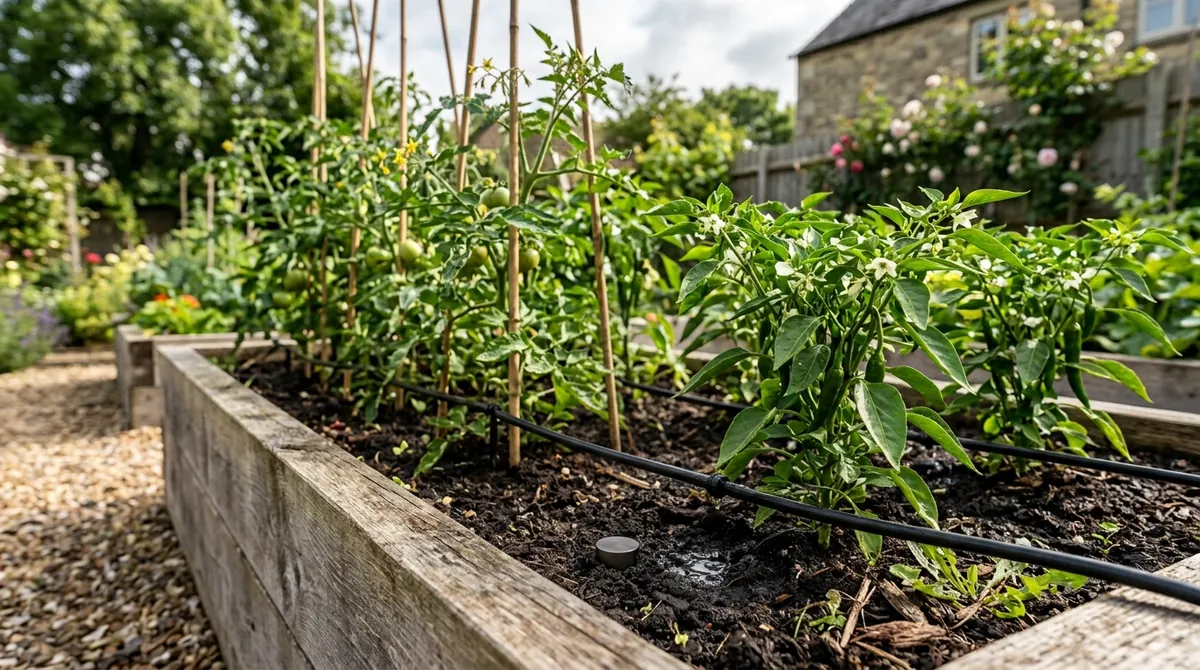
Vegetable beds, chilis and peppers: temperature tiers, plus a probe. What matters is steady moisture in the root zone. Peppers in particular don't like drying out, so a probe that brings a watering forward is worth having. Tiers are easy to reason about, and the probe does the fine-tuning.
Tomatoes: tiers or ET, plus a probe. A big tomato plant in hot sun drinks a lot, and ET follows that well, provided you choose the crop factor with care. If you would rather not think about it, use tiers.
Fruit trees, tropical or not: temperature tiers with deep soaks, and a probe at root depth. An established tree is not watered to replace yesterday's loss. It gets a deep soak every so often so the roots go down. ZoneFlow's deep soak is made for this, and the tiers set how often. A probe at root depth tells you whether the water really got down there. In a wet tropical season the rain credit and the dry-down hold after heavy rain matter more than the method does.
Sandy soil: a probe helps most here. Sandy soil holds little water and dries quickly, and no weather formula knows that. The probe does.
Shrubs, young plants, seedlings and pots: temperature tiers. Small root systems and small amounts of soil dry out on their own schedule, and a rule you can see is easier to trust. A probe is very useful in a pot, because the size of the pot decides how long the water lasts and the probe sees that for itself. For anything newly planted, turn on the growth ramp so it starts with less water and builds up from the planting date.
Greenhouses and indoor spaces: the climate settings, and a probe. Outdoor weather says little about what is happening under a roof, and rain never tops a greenhouse bed up, so the soil's own reading is the truth. A greenhouse zone looks after the air with its own fans, vents, misters and heater. See Greenhouse and indoor zones.
Dry, sunny climates with a large planting: ET. The bigger and more uniform the planting, and the more regular the weather, the more the ET curve helps.
No sensors at all: temperature tiers. They work well for most home gardens, and you can add the other things later.
What helps whichever one you pick
The method only decides how much water the plants should get in a week. These settings decide what really happens:
- Rain. A rain gauge, rain you type in by hand, or nearby weather stations take what has already fallen off the amount. See Rain without a gauge if you have no gauge.
- A soil probe. As above, it checks the method against the real soil.
- The weather forecast. A watering can be held back before rain.
- The mulch adjustment, from minus 50 % to plus 70 %. It is a correction for your own garden: lower for heavy soil, shade or thick mulch, higher for bare, sunny ground. Whichever method you use, this is the dial to turn if a zone always seems a bit too wet or too dry.
- Deep soak and routine watering. Deep roots get an occasional long soak, with lighter top-ups in between.
If you are not sure, start with the temperature tiers and add a probe when you are ready. You can switch a single zone to the ET curve later without touching the rest. The details are in How it decides, What each sensor adds and Growth ramp and climate.
Where this comes from
ET, crop factors and soil sensors are not my invention, and the limits above come from the people who study them.
- The Food and Agriculture Organization's irrigation guide describes crop water use as ET times a crop factor, for healthy crops with enough water, and says the factor changes with the crop and its growth stage. See Crop evapotranspiration under standard conditions and The single crop coefficient.
- University of Minnesota Extension explains scheduling by water balance: rain and irrigation go in, ET goes out, and you water when the soil has dried to a set point. See Evapotranspiration-based irrigation scheduling. The same university covers how soil moisture sensors are affected by soil conditions and placement: Soil moisture sensors for irrigation scheduling.
- University of California Agriculture and Natural Resources says soil moisture sensors need calibrating for your site and that the right dry point depends on the crop, the irrigation system and the root depth. See Soil Moisture Sensors.
- Virginia Tech Extension explains setting the dry point by crop and soil, and using a shallow and a deep sensor together to see whether the water reached the roots. See Scheduling irrigation based on soil moisture content.
- A 2023 review of studies from the United States found that scheduling by soil water sensors generally used less water than other methods with similar or better yields. See Soil water sensors for irrigation scheduling in the United States.
- Oklahoma State University Extension reviews soil moisture controllers for lawns. See Smart irrigation technology: controllers and sensors.
- Utah State University Extension covers using ET to water a landscape, and why different plants need a plant factor. See Watering the landscape with ET and Maintaining a water-wise landscape.
- The University of Arizona Cooperative Extension recommends more frequent watering for newly planted trees and shrubs, and letting established ones dry between waterings. See Watering trees and shrubs.