
Several Irrigation Valves on One Pump: How to Set Them Up
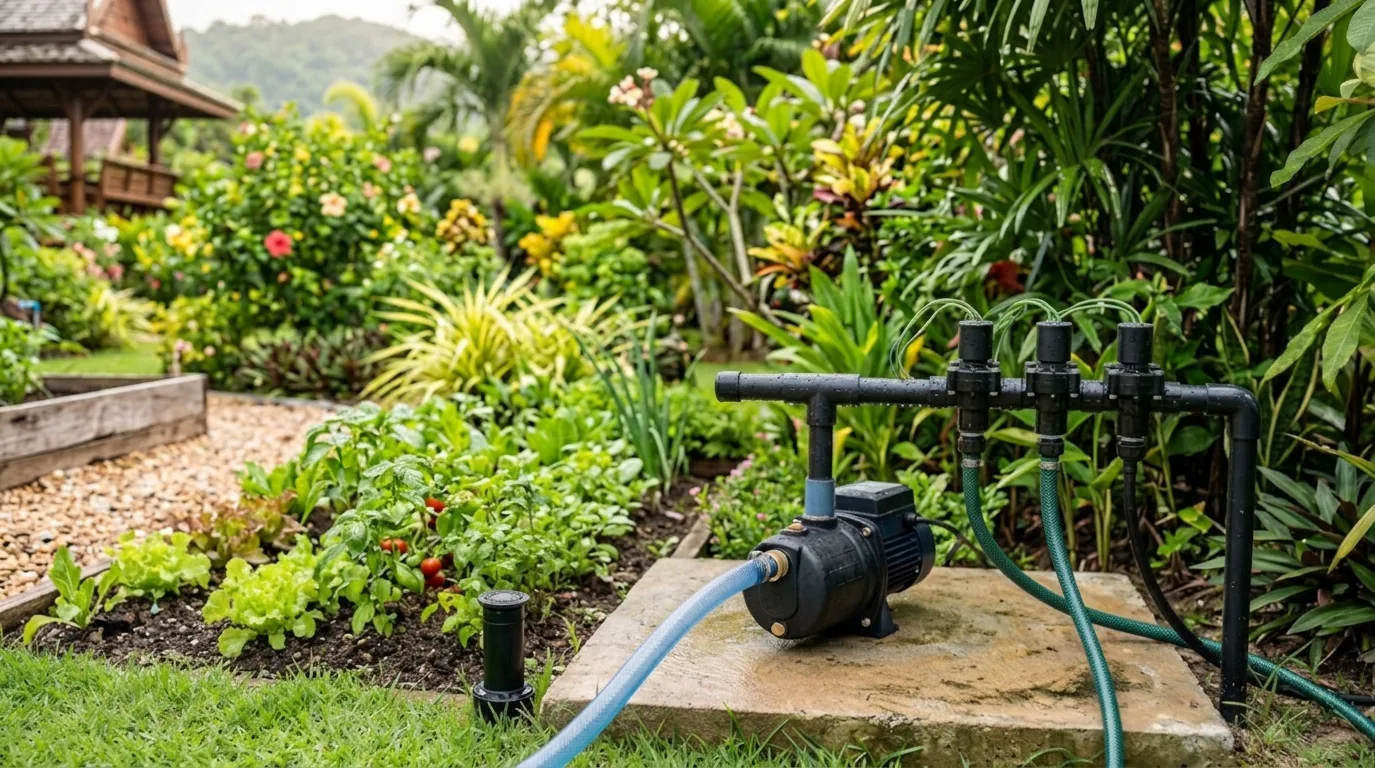
Most gardens have more than one irrigation zone and only one water source, whether that is a pump, a well or the town supply. A lawn, a vegetable bed and a row of fruit trees all take their water from the same place, each through its own valve.
That works well as long as only one valve is open at a time. The trouble starts when two open together, and ZoneFlow has a simple way to stop that from happening.
Why two valves at once is a problem
A pump can only push out so much water per minute. Open one valve and the zone gets nearly all of it. Open two and the pump splits its flow between them, so each zone gets less than before.
That matters because ZoneFlow works out how long to water from the flow rate you measured for each zone. If you measured that zone on its own, the number assumes it has the pump to itself. Run it next to another zone and it waters for the planned time but puts down less water than ZoneFlow thinks. Your plants end up thirstier than the plan says, and nothing looks wrong.
The fix: give the zones the same Shared pump ID
In each zone's setup, or later under Configure, there is a field called Shared pump ID. It is just a label. Type the same label, for example Pump A, in every zone that draws from that pump.
Zones with the same label take turns. One zone holds the pump for its whole watering, including the resting gaps between pulses, and the next zone waits until it is finished. While it waits, the zone's Status says it is waiting for the shared pump, so you can see what is going on.
Zones with a different label, or none, never wait for each other and can run at the same time.
A few details worth knowing:
- Set the label explicitly for every shared pump. It does not matter whether you have a pump power sensor.
- A garden with two pumps just uses two labels. If the lawn and the beds share
Pump Aand the trees have their own pump, give the treesPump Bor leave it empty. The trees will then run whenever they are due, and the lawn and beds will take turns. - If you have a flow meter in front of several separate pumps, it can't tell their water apart. Either give those zones the same label so they take turns, or fit one meter per pump.
More detail is in Multiple zones and shared pumps.
Can your pump actually do the job?
Taking turns means the pump only has to supply one zone at a time. So the question is whether it can supply your biggest zone. A bucket and a watch will tell you.
- Take a bucket you know the size of, say 10 litres.
- Open the supply at the pump end, with a short hose if you need one, and time how long the bucket takes to fill.
- Divide the bucket size by the seconds and multiply by 60. That is litres per minute.
For example, a 10 litre bucket that fills in 15 seconds gives 10 ÷ 15 × 60 = 40 litres per minute, or 2,400 litres per hour.
Pipes, filters and fittings use up some of that on the way to the plants. A common rule of thumb is to count on about 80 per cent of what you measured at the pump. In the example that is roughly 1,900 litres per hour.
Now compare it with what your zones use. If your sprinkler zone uses 1,500 litres per hour and the bed zone uses 900, either one alone is fine. Both together would need 2,400, which is more than the pump can deliver, so letting them run together would shortchange both. That is the case where a shared label pays off.
For the zones' own flow, use the number you measured for each zone, as described in how to measure your irrigation flow rate with a bucket. That figure already includes the losses on the way, so the 80 per cent rule is only for checking whether the pump can cope.
No pump? Mains water works the same way
Everything above applies if your water comes from the town supply instead of a pump. Your house pipes can only deliver so much water per minute, and that limit is shared by every valve you open. Two zones open at once split it, just like with a pump.
The bucket test is the same too. Do it at the tap or connection your irrigation is fed from, and fill the bucket with nothing else running in the house.
A few things are different with mains water:
- The number can change through the day. In the early morning there is usually less demand and more pressure than in the evening. Test at about the time your zones normally run.
- The house shares it. A shower, a washing machine or a toilet filling while a zone runs takes water from the same pipe. Scheduling watering for when the house is quiet helps.
- Narrow pipes limit you. An older house or a long thin pipe to the garden can deliver much less than the town supply could. If your bucket test gives a low number, the pipe is likely the reason, not the supply.
The field is called Shared pump ID, but it is only a label that tells zones to take turns. If several zones are fed from the same mains connection, give them the same label and they will queue the same way.
Do I even need to share? A simple test
A bigger pump may handle two zones at once without any trouble. You can check this yourself.
- Measure the flow of one zone on its own, with the catch-cup method from the other post.
- Measure it again while the second zone is running.
If the numbers are the same, the pump has room to spare and those two don't need to share a label. If the second reading is clearly lower, share them.
If the pump needs a moment
Some pumps need a few seconds to build up pressure after they start, and a few more to settle after the valve closes. If your zones show different flow rates than you expect, or the first minute of a run seems weak, look at two settings on the zones that share the pump: Pump Preamble (Warm-Up Delay) and Pump Postamble (Settle Delay). Each goes from 0 to 60 seconds and starts at 0.
The preamble is the delay after the pump starts before the valve opens. The postamble is the delay after the valve closes before the next waiting zone can start. If you don't notice any problem, leave both at 0.
A short checklist
- Which zones are on which pump? Write it down.
- Give every zone on the same pump the same Shared pump ID.
- Do the 10 litre bucket test at the pump, and check your largest zone fits.
- Measure each zone's flow rate on its own.
- Check the Status of a zone that seems late: if it says it is waiting for the shared pump, it is in the queue and nothing is broken.